


Care instructions
Care Instructions for Damascus Knives
A MISAKI knife is a precision tool. With the right care, the edge stays sharp for longer, the surface remains beautiful and the handle stays stable over time. This guide is deliberately detailed so that you can use your knife safely and preserve it for many years.
Quick start: the most important rules
- Clean the knife by hand immediately after use and dry it straight away.
- Avoid the dishwasher, soaking and aggressive cleaners.
- Cut only on wood or soft plastic.
- No bones, nothing frozen and no hard pits.
- Store the knife so that the edge does not touch anything.
- Sharpen in a controlled way and without much pressure.
- For longer storage, a very thin film of oil protects the blade.
1. Cleaning after every use
Correct cleaning is essential for preserving the quality of your knife.
How to clean your Damascus knife correctly
- Briefly rinse the blade with warm water.
- Use mild dish soap.
- Clean with a soft sponge or cloth.
- Dry thoroughly immediately, including the transition to the handle.
MISAKI tip: A soft cloth prevents fine scratches and ensures a clean finish after drying.
What you must avoid
- Dishwasher.
- Leaving the knife in the sink or in water for a long time.
- Abrasive sponges, scouring cream, steel wool.
- Cleaners containing chlorine or strong alkaline cleaners.
If something sticks
Place a damp cloth briefly around the blade, loosen residue gently, rinse and dry the knife again immediately.
2. Cutting surface: the basis for a long-lasting edge
The cutting surface determines how long your edge stays fine. Surfaces that are too hard dull the blade quickly and can cause micro-chipping.
Recommended
- Wood, ideally soft to medium-hard woods.
- Soft plastic boards.
Not suitable
- Glass.
- Stone, granite, marble.
- Ceramic.
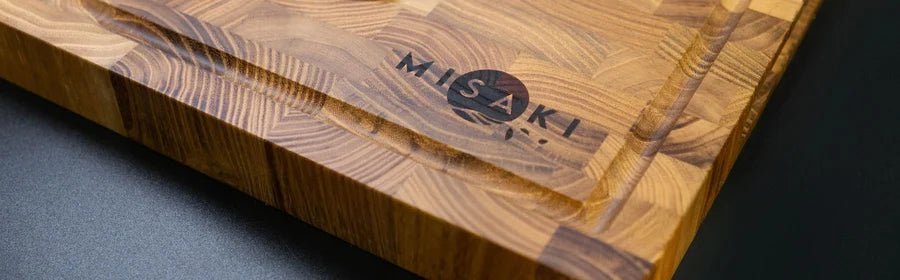
MISAKI tip: Teak is especially gentle on knives, dimensionally stable and pleasant for daily use. It shows little wear even over a long time and remains permanently beautiful.
3. Blade care: Damascus steel, discoloration and rust
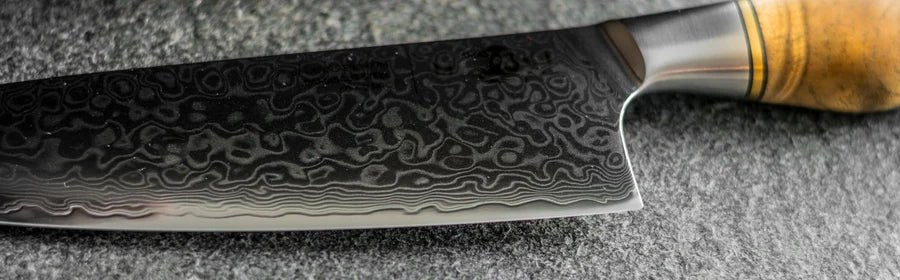
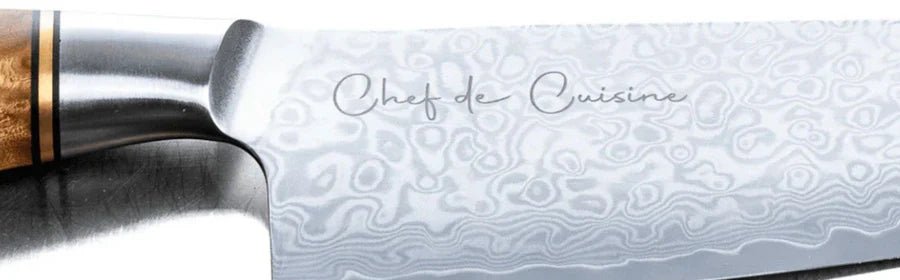
MISAKI Damascus knives from the HIKARI and AKANE series have outer layers made of stainless steel. This makes the blade very robust and rust-resistant in daily use. Nevertheless, moisture, salt and acids can leave traces over time, especially at the edge and at the finest transitions.
Discoloration in daily use
Onions, citrus fruits, tomatoes or salt can cause light spots. These are usually superficial. Cleaning and drying is normally sufficient.
Removing rust with baking soda
If you discover small rust spots, they are often flash rust and can be removed gently.
- Mix baking soda with a few drops of water to make a paste.
- Apply the paste to the affected area.
- Rub very gently with a soft cloth.
- Rinse with warm water and dry completely immediately.
- If needed, apply a very thin layer of oil afterwards.
Important: Do not use coarse abrasives, so the Damascus pattern is not attacked unnecessarily.
Camellia oil as protection
For additional corrosion protection, especially during longer storage or high humidity, we recommend camellia oil. It is food-safe, very thin and ideal for blade care.
View the camellia oil
View all care products
4. Handle care
Wood is a natural material. With a little care, it stays beautiful and stable for years.
Basic rules
- Do not leave the handle lying in water.
- After drying the blade, briefly wipe the handle dry as well.
- Do not use aggressive cleaners on wood.
When care makes sense
If the wood looks dry or feels rough, apply a small amount of care oil thinly. Let it absorb and wipe off the excess. Camellia oil is also suitable for handle care.
5. Storage
Correct storage protects the edge, prevents scratches and increases safety.
Knife blocks and magnetic strips
- Knife block: looks elegant and tidy on the worktop and presents your knives as a stylish element in the kitchen.
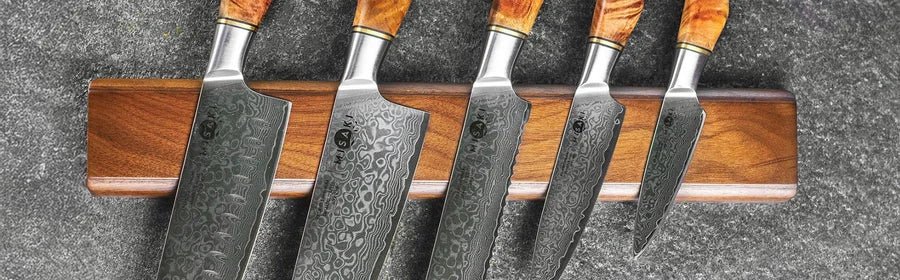
- Magnetic strip: presents the knives like in a professional kitchen, creates a clear, modern look and turns your favourite knives into an eye-catcher.
View knife blocks and magnetic strips
Knife guards and knife boxes
- A knife guard or saya protects the edge in drawers.
- A knife box is ideal as a gift box for individual knives and for safe, dust-protected storage.
View knife guards and knife boxes
Knife roll for transport
For transport and travel, a knife roll is the safest solution. It protects the edge and tip and prevents contact with other objects.
6. Sharpening and maintaining sharpness
Sharpness is care. The harder the steel, the more important calm movements, a clean angle and little pressure become. For MISAKI, we distinguish three levels plus the professional service.
Diamond sharpening rod: quick touch-ups between sharpenings
Ideal when sharpness decreases in daily use and you quickly want clean bite again. The diamond sharpening rod removes material. Use it deliberately for touch-ups between sharpenings.
View the diamond sharpening rod
View guide with images
Whetstone 1000 and 6000: basic sharpening and fine sharpening
If the knife is clearly dull or if you want to rebuild the edge cleanly, the whetstone is the best choice.
- 1000 grit side for thorough basic sharpening.
- 6000 grit side for fine sharpening.
View the whetstone 1000 6000
View guide with images
Leather strop: ultimate fine finish and mirror-smooth edge
With the leather strop, you refine the edge after the stone or keep sharpness elegantly at a high level. Work with minimal pressure and controlled strokes.
View the leather strop
View guide with images
MISAKI sharpening service
If you would like the condition of your blade professionally refreshed, a sharpening service is ideal. This is especially worthwhile for heavily used knives or when you want maximum precision.
7. Correct cutting and why hardness matters
Cutting technique
- Cut with a controlled pull or push.
- Avoid strong downward pressure.
- Use the blade length and let the edge do the work.
Do not put leverage on the tip
The tip is a precision part. Do not expose it to leverage, for example when prying out pits or loosening hard foods. This is exactly how most tip damage occurs.
Hardness and cutting performance explained clearly
The higher the hardness of a steel in HRC, the finer the edge can be ground. This brings very high cutting performance and long edge retention. At the same time, very hard steel is less tolerant of incorrect strain. Lateral forces, hard impacts or cutting surfaces that are too hard can then lead more quickly to micro-chipping or a damaged tip.
In short: more hardness means more performance, but also more care in handling.
What you should not cut
- Bones and cartilage.
- Frozen food.
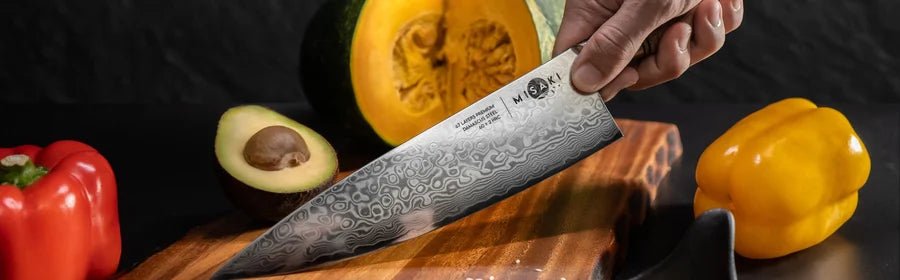
- Hard pits, for example avocado pits.
8. Care interval: a simple routine
After every use
- Hand wash.
- Dry immediately.
- Store safely.
As needed
- Apply camellia oil thinly, especially before a longer break.
- Touch up with the diamond sharpening rod.
- Basic sharpening and fine sharpening with the whetstone.
- Finish with the leather strop.
Frequently asked questions
Can I put my Damascus knife in the dishwasher?
No. Heat, chemicals and movement attack the blade, edge and handle.
Do I have to oil the blade?
Not daily. Oiling makes sense for longer storage, high humidity or when you want maximum corrosion protection.
Are HIKARI and AKANE rustproof?
The outer layers are stainless. Nevertheless, cleaning and drying are the best care, especially at the edge.
Which sharpening angle is correct?
Around 15 degrees per side is a very good guideline, provided you work calmly and evenly.
MISAKI, where quality meets art.


