
Sharpening Japanese Knives with a Sharpening Stone: Angle, Grit and Technique
 sharpening stone">
Japanese knives are known for their fine sharpness and precise cutting performance. To preserve these qualities over time, the right sharpening routine is essential.
A sharpening stone for Japanese knives is one of the best ways to sharpen Japanese knives thoroughly. It allows controlled material removal, rebuilds the edge cleanly and creates a precise cutting feel. The right sharpening angle, suitable grit and calm, even technique are especially important.
Why Japanese knives need careful sharpening
Japanese kitchen knives are often ground finer than classic European knives. The edge is more precise, but it can also react more sensitively to incorrect technique, too much pressure or unsuitable cutting boards.
That is why Japanese knives should be sharpened deliberately. The goal is not to remove as much material as possible, but to rebuild the edge in a controlled way. A water sharpening stone is particularly suitable because it works evenly and does not stress the blade unnecessarily.
Which sharpening angle is right for Japanese knives?
The right sharpening angle depends on the knife, steel and blade geometry. Many Japanese kitchen knives are roughly in the range of 10° to 15° per side.
A smaller angle enables a very fine edge, but also makes the blade more sensitive. A slightly larger angle offers more stability in everyday use. The decisive factor is therefore not the smallest possible angle, but the angle that fits the individual knife.
MISAKI blades with a smooth V-grind are set at 15° per side. More details can be found in our care instructions.
Which sharpening stones are suitable for Japanese knives?

Sharpening stones are available in different materials and designs. Synthetic water stones, ceramic sharpening stones, natural stones and diamond-coated sharpening stones are commonly used.
Water stones are especially popular for Japanese kitchen knives because they work in a controlled way and are well suited to fine edges. During sharpening, they create a fine slurry on the surface that supports even material removal.
Diamond-coated sharpening stones usually remove material faster and can be efficient with very hard steels. They should be used deliberately, however, because they can work more aggressively depending on the application. Natural stones are particularly traditional, but can vary significantly from stone to stone. For many users, high-quality synthetic water stones are the most reliable and predictable solution.
Which sharpening stone grit makes sense?
Not every sharpening stone serves the same purpose. Coarse, medium and fine grits are used for different steps.
A coarse grit of around 400 to 800 is suitable for very dull or slightly damaged blades. It removes more material and should only be used when a stronger correction is truly needed.
A medium grit around 1000 is ideal for regular resharpening. It restores an edge that has lost performance and is suitable for routine care.
A finer grit between about 3000 and 6000 is used for finishing. It refines the edge, smooths the surface and improves the cutting feel.
Very fine grits from around 8000 upward are more for polishing or special applications. For most kitchen knives, a combination of medium and fine grit is sufficient. A 1000/6000 sharpening stone therefore covers most use cases for Japanese knives.
Sharpening Japanese knives with a sharpening stone: step by step
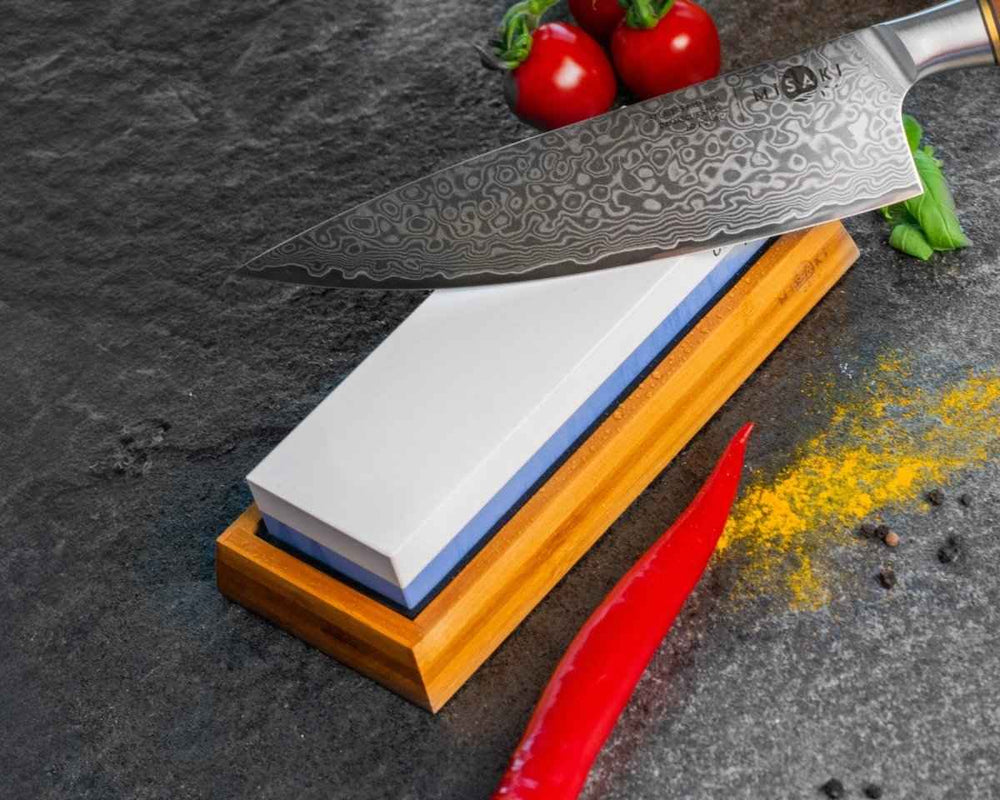
In principle, every sharpening process follows the same pattern: soak the stone, set the knife at the right angle, begin with a medium grit and finish with a finer grit. Final stropping on a leather strop removes the last burrs and creates an especially clean finish. A visual step-by-step guide for the MISAKI water sharpening stone can be found here.
Sharpening a Santoku knife correctly
A santoku knife is sharpened in the same basic way as other smooth-edged Japanese kitchen knives. Here too, an even angle and calm guidance over the stone are essential.
Because santoku knives are often used for fine push cuts through vegetables, fish and meat, a careful finish is particularly worthwhile. A clean, smooth edge helps the knife glide precisely through the food.
If your santoku has kullens on the side of the blade, these do not affect the cutting edge itself. The kullens help food stick less to the blade. The cutting edge is sharpened in the usual way.
Common sharpening mistakes
The classic mistakes are too much pressure, a changing angle and a stone that is not soaked enough or is unstable. All of them lead to an uneven, unclean edge.
The wrong grit sequence is also often underestimated. If you start directly with a fine grit without first using a coarser grit where needed, sharpening takes much longer and often does not create a clean base edge. A wet or dirty blade before sharpening can also affect the result. The edge should be clean and dry before sharpening.
When should you have Japanese knives sharpened?
Not every knife needs to be sharpened by yourself. With very dull blades, chips or uncertainty about the angle, a professional sharpening service is often the safer choice. This is especially true for high-quality Damascus knives when the original cutting performance should be restored as precisely as possible.
If you care for your knives regularly, you can handle many touch-ups yourself. For a thorough restoration of the edge, the MISAKI sharpening service is a suitable option.
Sharpening stone, diamond sharpening rod or stropping leather?
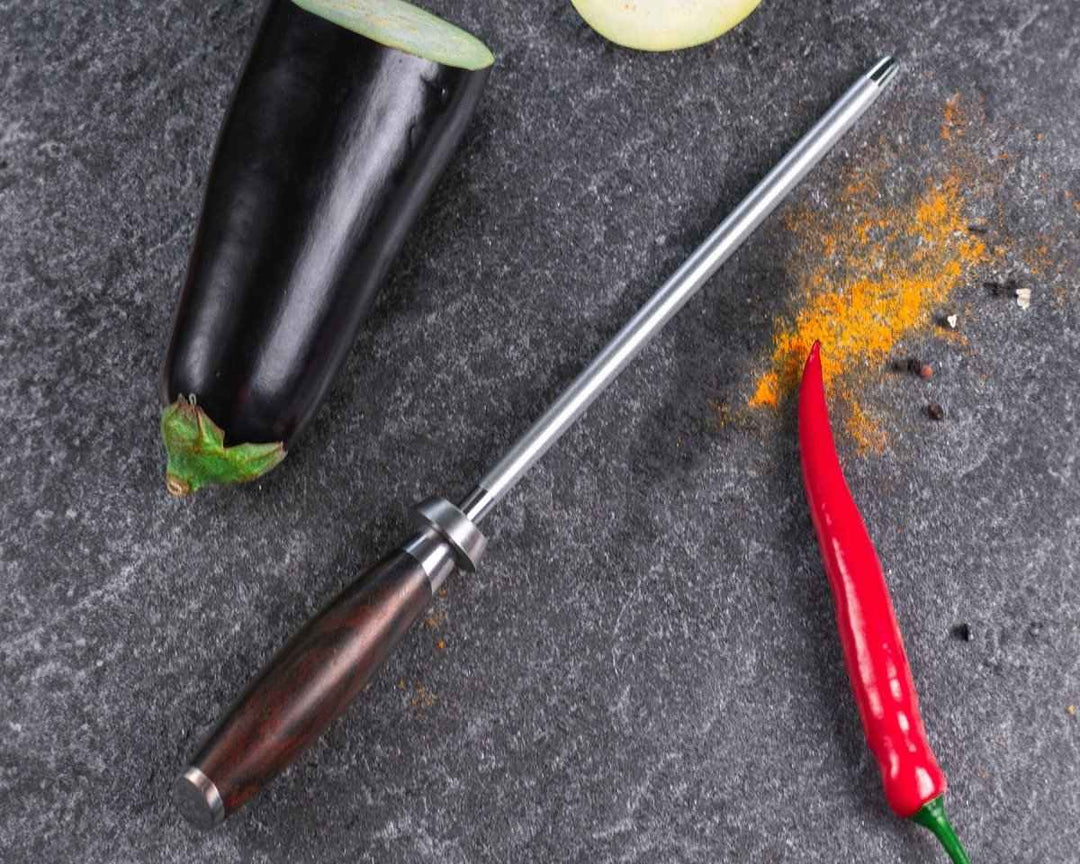
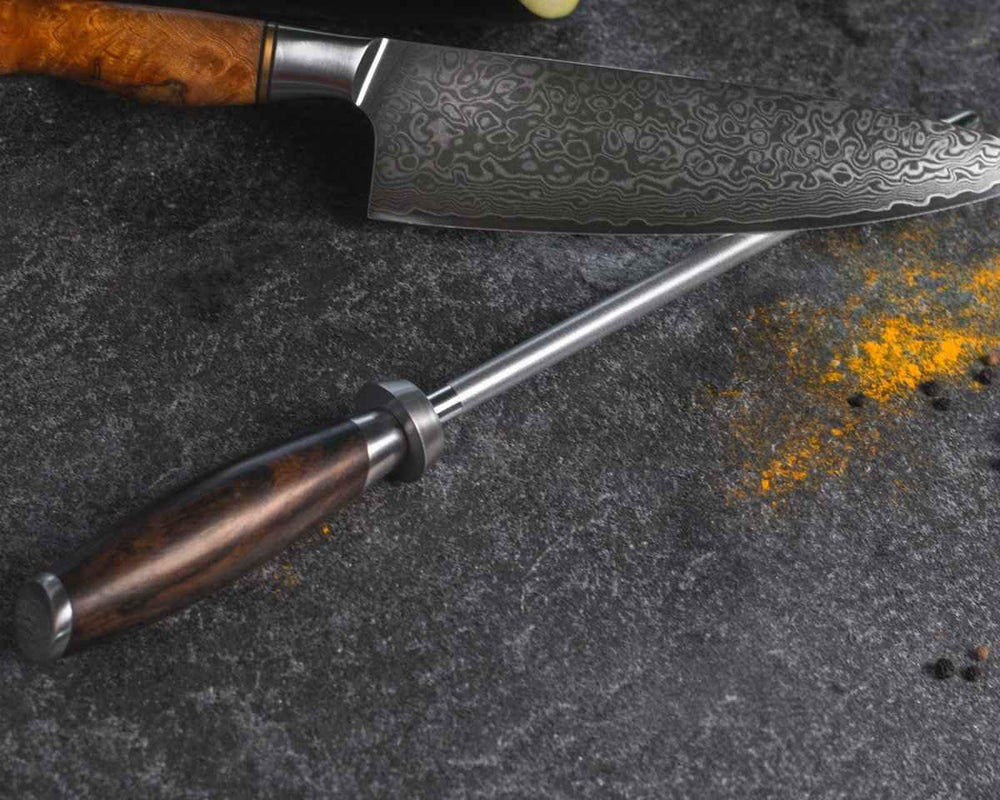
The sharpening stone actually rebuilds the edge. That is the main difference compared with the other two tools. Diamond sharpening rod and stropping leather extend the time between two sharpening stone sessions: the diamond sharpening rod quickly refreshes sharpness in everyday use, while the stropping leather provides a fine finish and removes the last burrs. Neither replaces a base sharpening on the stone when the blade has become truly dull.
A detailed comparison of all three tools, including a comparison table, can be found in our article on sharpening Damascus knives.
Your MISAKI sharpening stone
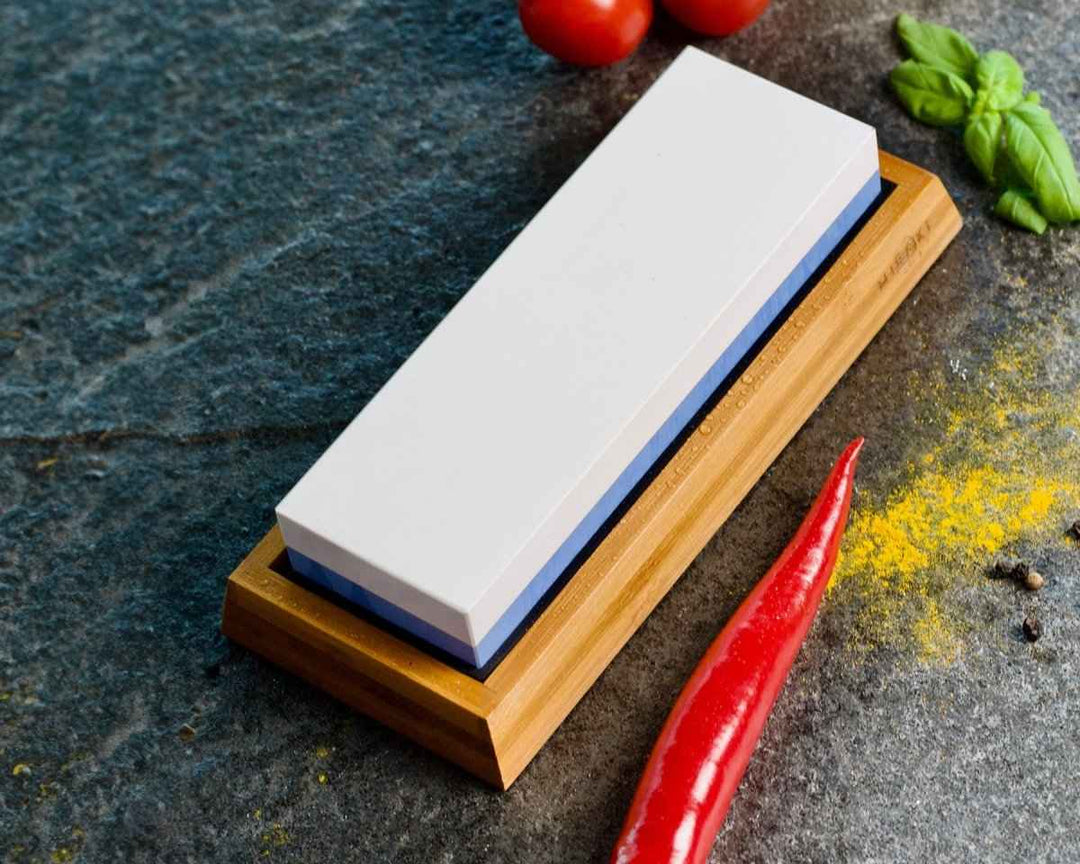
With the MISAKI water sharpening stone, you rebuild the edge of your Japanese knife precisely. Two grits (1000/6000) cover base sharpening and fine finishing in one set. If you prefer to leave sharpening to professionals, the MISAKI sharpening service offers a professional alternative.
Unsure which grit or method suits your knife? Contact us. We will be happy to advise you personally.
FAQ
Which sharpening angle is right for Japanese knives?
Most Japanese kitchen knives are between 10° and 15° per side. MISAKI blades with a smooth V-grind use 15° per side. Bread knives are an exception because they have a serrated edge.
Do I need to use both grit sides every time I sharpen?
Not necessarily. The medium grit is mainly used when the blade has become noticeably dull and the edge needs to be rebuilt. If the knife is only slightly losing performance, the finer grit alone is often enough for a quick refresh.
Which sharpening stone is easiest for beginners?
Synthetic water stones such as the MISAKI water sharpening stone are the easiest for beginners. They work predictably and evenly, without the aggressiveness of diamond stones or the inconsistency of many natural stones. With some practice in angle and pressure, good sharpening results are possible even without prior experience.
Can you sharpen a Santoku knife with a sharpening stone?
Yes, a Santoku knife is sharpened in the same basic way as other smooth-edged Japanese kitchen knives. The notes on angle and technique above apply here as well.
Should you sharpen Japanese knives yourself or have them sharpened?
As a rule of thumb: slightly dull blades can be resharpened yourself with some practice. For chips or severe dullness, the MISAKI sharpening service is the safer choice.
Can you sharpen a Japanese Damascus knife with a sharpening stone?
Yes, high-quality Damascus knives can be sharpened with a suitable water sharpening stone. Controlled technique is important so that the fine edge is not stressed unnecessarily.
Does a sharpening stone need to be soaked before sharpening?
Yes, a water sharpening stone should be soaked before use until no more air bubbles rise. The stone then works more evenly and the blade can be guided with better control.